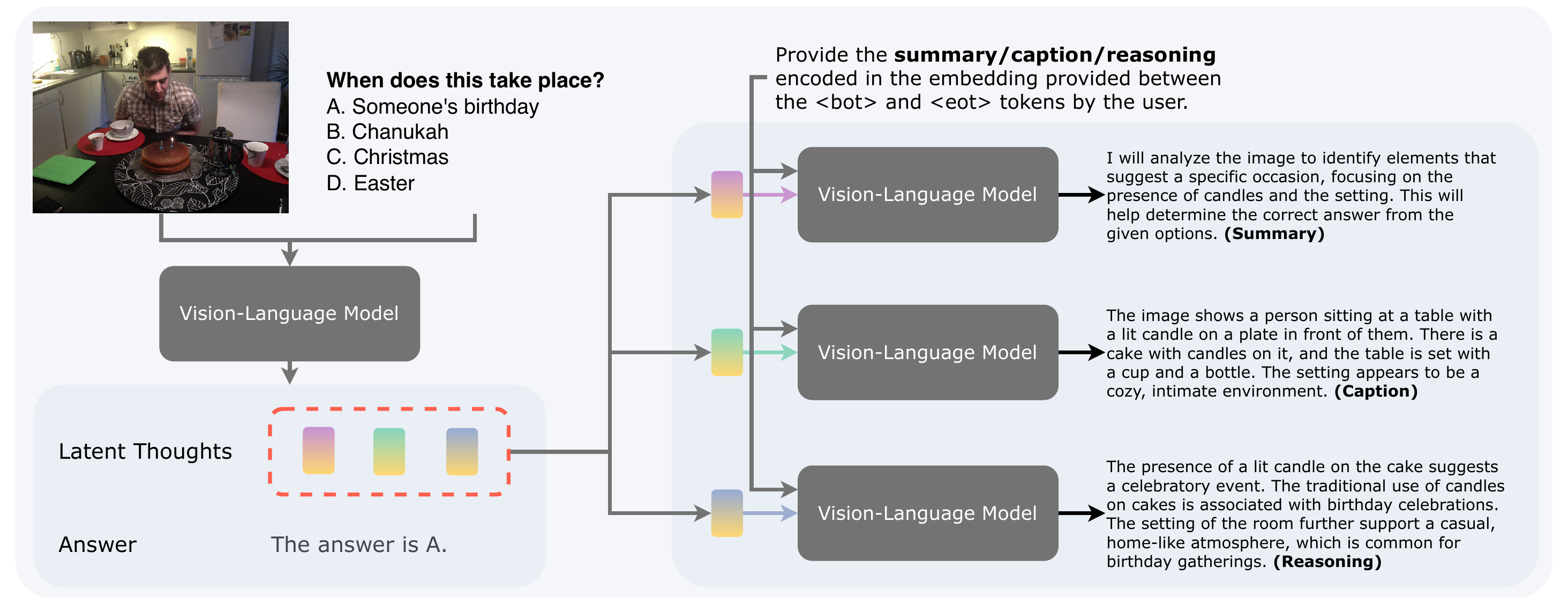
Latent reasoning has emerged as a powerful alternative to text-based Chain-of-Thought (CoT), offering significant gains in computational efficiency by compressing verbose reasoning into compact embeddings. However, compressing reasoning into the latent space renders the thinking opaque, hindering its interpretability. Current methods present a stark trade-off: they either function as unexplainable "black boxes" (e.g., Coconut), where the latent reasoning is not human-readable, or rely on separate post-hoc decoders for explainability (e.g., Heima), introducing architectural overhead and decoupling the explanation from the actual reasoning process.
In this work, we present a unified framework for Self-Explainable Latent Reasoning (SELR) that trains a single model to perform efficient and inherently explainable latent reasoning. Our core contribution is a novel multi-task training objective that optimizes for two goals simultaneously: (1) an Answer Loss that optimizes the latent reasoning trajectory to produce accurate final answers, and (2) a CoT Loss that explicitly trains the same model to decode its own latent representations back into human-understandable reasoning steps. This design ensures that generated latent representations are both task-effective and semantically interpretable, eliminating the need for external decoders. We validate the effectiveness of SELR on both Large Language Models (LLMs) and Vision-Language Models (VLMs), demonstrating that SELR achieves superior token efficiency and accuracy compared to baselines, while uniquely providing self-contained explainability without auxiliary models.
SELR addresses two challenges in existing latent reasoning models: a lack of supervision (there is no direct ground truth for continuous thoughts) and a lack of interpretability (we cannot tell what the model is "thinking"). Our central design is a multi-task learning objective that trains a single model to be both an efficient latent-space reasoner and its own latent-to-language translator.
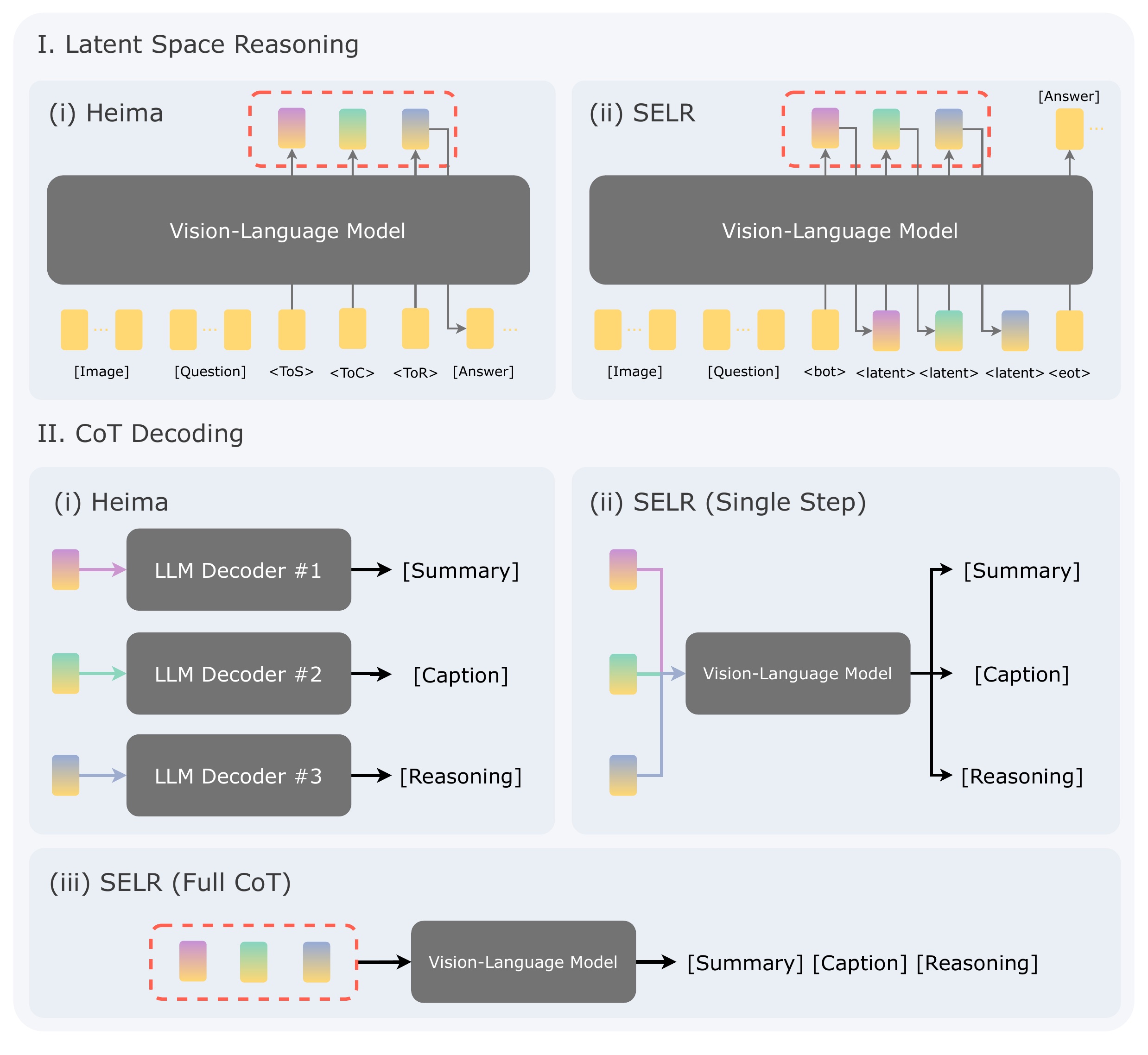
Figure: The SELR framework. (I) Latent Space Reasoning: the model generates a sequence of latent thoughts and a final answer from the image and question. (II) CoT Decoding: the very same model decodes its own latent thoughts into human-readable text. Unlike Heima, which trains separate per-step decoders, SELR uses one shared model.
For each image-question pair with ground-truth reasoning steps and final answer, SELR optimizes a weighted sum of two losses:
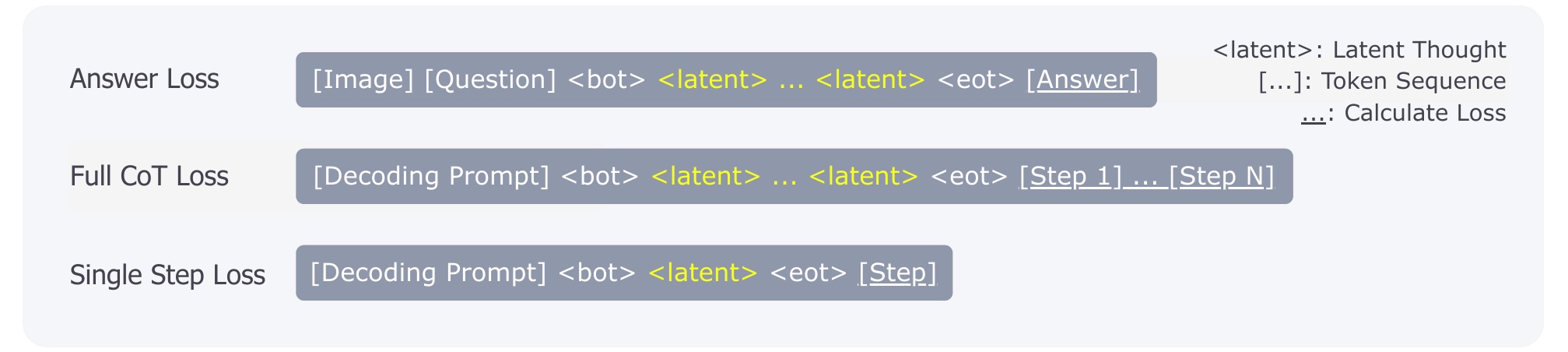
Figure: SELR's multi-task objectives. The Answer Loss supervises task accuracy, while the Full CoT and Single Step losses force latent thoughts to remain decodable into human-readable reasoning.
We provide both single-stage training (jointly optimizing Answer + Full CoT losses with a fixed latent length) and a multi-stage curriculum. The multi-stage method first aligns latent thoughts with ground-truth reasoning steps using variable latent length and the Single Step Loss, then refines with a fixed latent length. Inspired by Coconut's curriculum, this is critical for LLMs and also helps VLMs by exploiting the fixed three-stage (summary → caption → reasoning) structure of LLaVA-CoT-100k.
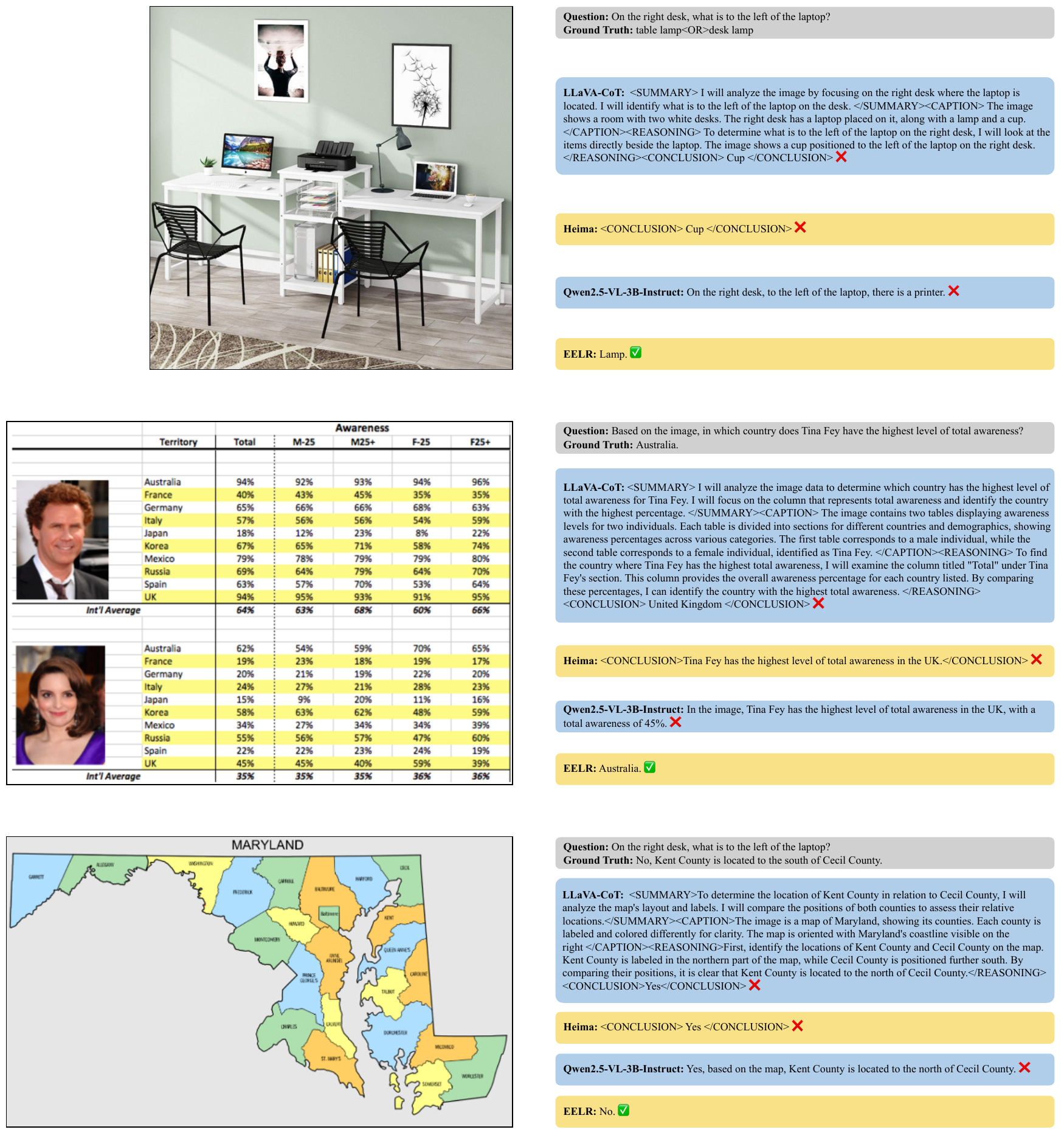
On six VLM benchmarks (MMStar, MMBench, MMVet, MathVista, AI2D, HallusionBench), SELR improves average accuracy over the base model by up to +0.86, while reducing response length by over 70%. In contrast, Heima's method degrades accuracy by 1.92 points.
| Method | MMStar | MMBench | MMVet | MathVista | AI2D | Hallusion | Avg. Acc. ↑ | Avg. Tokens ↓ |
|---|---|---|---|---|---|---|---|---|
| Qwen2.5-VL-3B-Instruct | 54.27 | 76.70 | 44.36 | 62.40 | 78.01 | 61.41 | 62.86 | 49.92 |
| Qwen2.5-VL-3B-Instruct-SFT | 55.47 | 72.37 | 44.82 | 56.40 | 78.30 | 60.15 | 61.25 | 218.78 |
| Heima | 53.60 | 75.93 | 34.26 | 59.90 | 79.37 | 62.57 | 60.94 (−1.92) | 22.84 (−54%) |
| SELR (Answer Loss Only) | 56.27 | 76.63 | 36.38 | 61.50 | 78.30 | 59.94 | 61.50 (−1.36) | 15.58 (−69%) |
| SELR (Single) | 57.27 | 76.32 | 41.88 | 65.10 | 78.95 | 62.78 | 63.72 (+0.86) | 15.72 (−69%) |
| SELR (Multi, Uniform) | 57.27 | 77.40 | 38.99 | 64.30 | 79.89 | 62.99 | 63.47 (+0.61) | 13.32 (−73%) |
| SELR (Multi, Exponential) | 56.40 | 78.72 | 36.10 | 64.30 | 80.31 | 64.04 | 63.31 (+0.45) | 13.47 (−73%) |
On math reasoning benchmarks, SELR (Multi) consistently outperforms Coconut and our own single-stage variant on both in-domain (GSM8k) and out-of-distribution (SVAMP, GSM-Hard, MultiArith) tests, while remaining competitive with CoLaR using fewer latent tokens.
| Model | GSM8k | SVAMP | GSM-Hard | MultiArith |
|---|---|---|---|---|
| Coconut | 30.83 | 36.33 | 0.00 | 80.00 |
| CoLaR | 40.10 | 54.90 | 9.08 | 91.30 |
| CoT-SFT | 64.06 | 66.67 | 15.85 | 98.33 |
| SELR (Single) | 35.03 | 46.33 | 8.04 | 70.00 |
| SELR (Multi) | 42.46 | 49.67 | 9.78 | 81.67 |
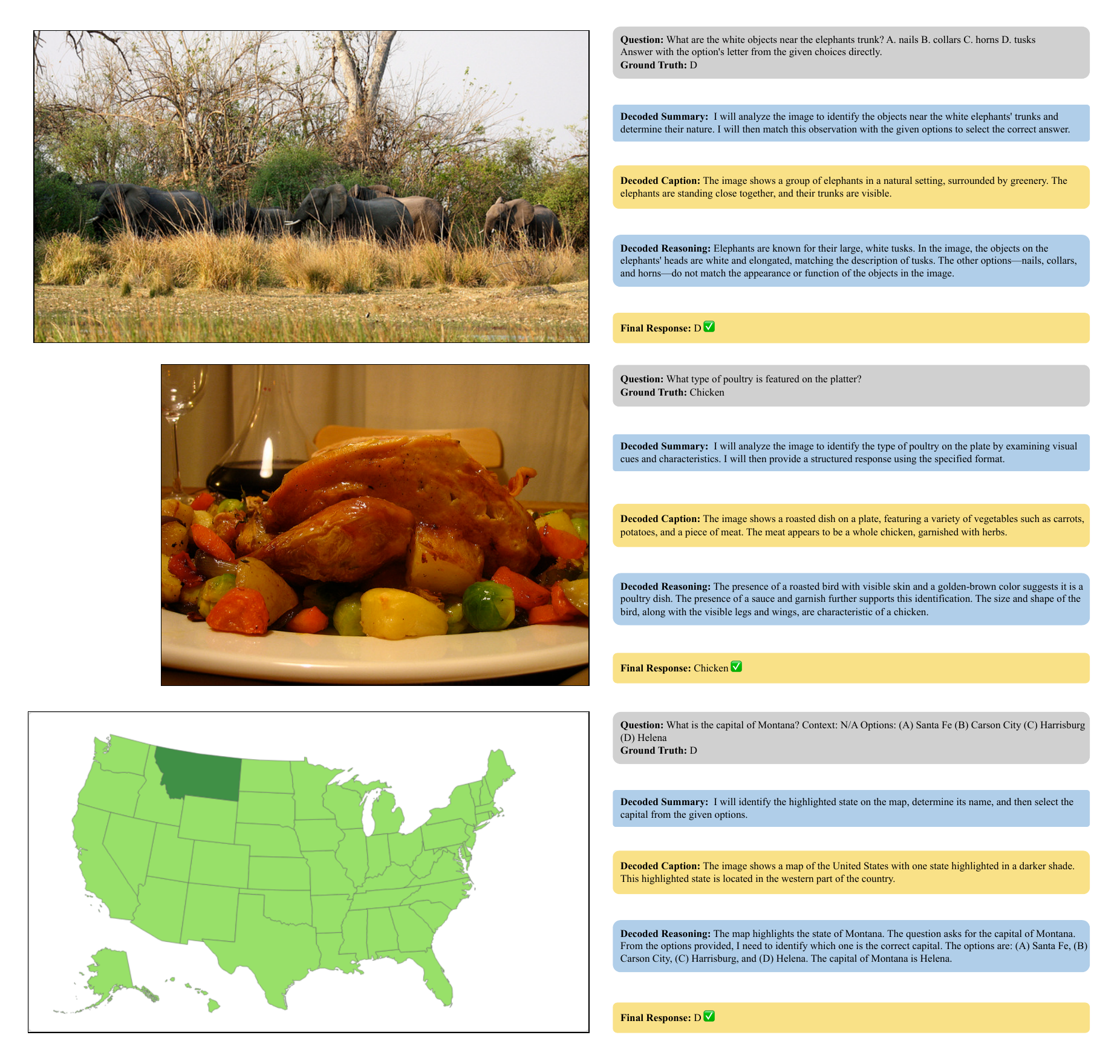
Given an image and a question, SELR generates a short sequence of latent thoughts and a final answer. Feeding those same latent thoughts back into the model with a decoding prompt yields a human-readable summary, caption, and step-by-step reasoning—all from the single shared model.
@inproceedings{zhao2026selr,
  title     = {Think in Latent, Explain in Language: Self-Explainable Latent Reasoning},
  author    = {Zhao, Dayuan and Cao, Shengcao and Wang, Yu-Xiong and Gui, Liangyan},
  booktitle = {Proceedings of the International Conference on Machine Learning (ICML)},
  year      = {2026}
}